
Reorienting Toward Light: Finding Hope on the Edge of Athens

By Ridvan Idara Executive Director, New Era Creative Space

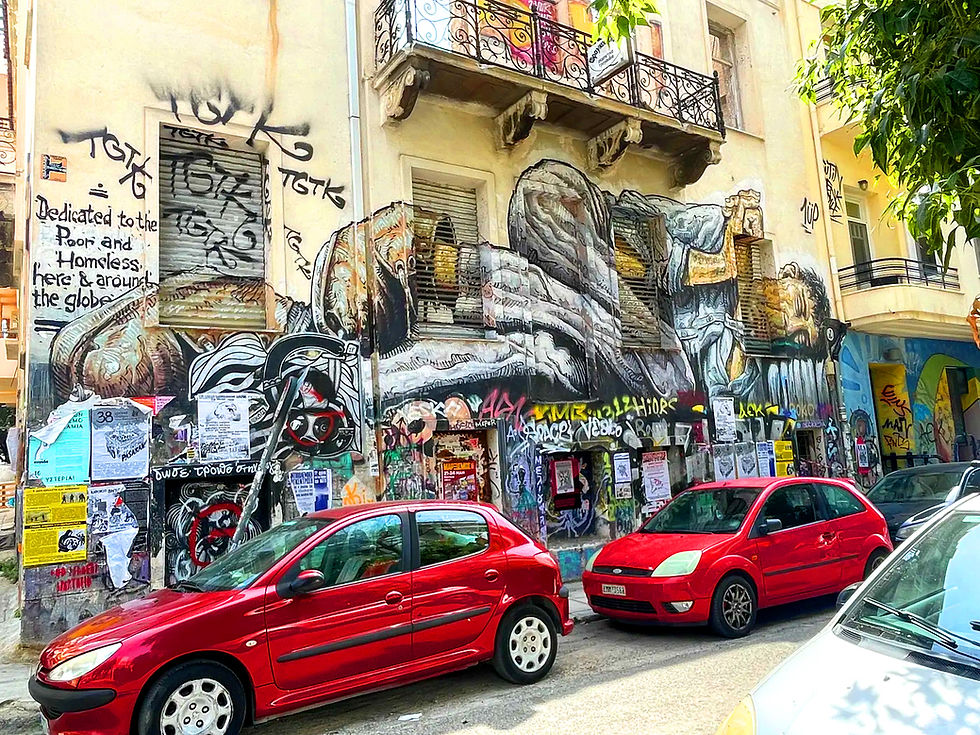
We arrived in Athens in the quiet, hours of the early morning, weary from a long trek through Morocco. As has been the theme of my sabbatical, I haven’t paid much attention to the finer details, choosing instead to lean into the current of the journey and let it carry me where I need to go. Our Airbnb was in the Charilaou Trikoupi neighborhood. At 2:00 AM, the city was a blur of shadows, but even through my exhaustion, I noticed the heavy presence of riot police stationed next door to our apartment. The walls were thick with graffiti, not the artistic murals of a gentrified district, but the jagged, urgent scrawl of a neighborhood that has something to say.
Athens has a long history of youth rebellion, rooted in high unemployment and a feeling of being abandoned by the “Old World” systems. For a moment, as a tourist staying in an Airbnb, I felt the sting of being part of the problem they were protesting. I looked at the walls and saw a profound loss of hope, a generation that feels the future has been sold off to the highest bidder. Yet, even in this rebellious atmosphere, we found a lovely little cafe serving pastries and thick Greek yogurt. As the holiday ended and the shops opened, the neighborhood transformed. We saw the real Athens: an endless sea of cafes, bookstores, pharmacies, and eyeglass shops. Eric noted that the coffee was consistently awesome, and I finally treated myself to authentic spanakopita and classic Greek salad. The intensity of the neighborhood began to feel less like a threat and more like authentic energy. It was a reminder that the most upscale path isn’t always the most honest one.
Looming literally above our apartment was Mount Lycabettus. We walked the uphill path two nights in a row because once simply wasn’t enough to take it all in. Standing at the peak, it was a breathtaking experience to see how dense the city truly is, building after building packed together like a mosaic of concrete and history. We stayed for dinner on the mountain, watching as the sun dipped and the Acropolis began to light up across the way. From that height, the pain on the walls below was invisible, replaced by a magnificent, glowing silhouette of human achievement. It offered a necessary perspective: the city is both its struggle and its beauty, existing simultaneously.
We eventually made our way to the Acropolis itself. Standing in the shadow of the Parthenon, one cannot help but feel the crushing weight of time. It is a masterpiece of man’s ingenuity, yet I found myself thinking of the hands that built it. While history often credits the statesman Pericles and the architect Phidias, these monuments were erected by thousands of laborers, including enslaved people and low-status craftsmen. It is a striking paradox. The hierarchy of rank and the massive egos of ancient rulers who created something of eternal beauty on the backs of those they deemed lesser. Looking from the ancient ruins back down toward the graffiti-covered streets of Charilaou Trikoupi, I realized that the struggle between the rulers and the rest hasn’t changed much in three millennia.
 |
Three days later, we transitioned from the gritty rebellion of Athens to the serene waters of Loutraki. As we drove uphill and away from the dense, bustling heart of the city, the landscape began to shift, trading concrete for the vast, open blues of the Gulf of Corinth. We arrived at the Ramada by Wyndham Loutraki Poseidon Resort, a beautiful sanctuary tucked away between the sea and the mountains. The resort felt almost purposely secluded, far from the distractions of any town. It was a peaceful place designed for reflection, keeping us focused entirely on the conference and the deep connections being made.
Follow Us & Stay Connected!
Website: www.necspace.org
Instagram: @necspace
Facebook: New Era Creative Space
Volunteer: NECS is actively seeking Volunteers. Learn more


Digitizing my grandparents' photo albums and every scan of the printed shots came out with that dot-pattern grit. Used to wrestle with VueScan's descreen filter — ten minutes a photo. This print moire fix does it in seconds and skin tones still look natural.